Four AI Giants Just Reviewed Our Architecture.
Here's What They Said.
Google Gemini, OpenAI's ChatGPT, Anthropic's Claude, and xAI's Grok independently evaluated the Who's In platform. Their conclusions are remarkable — and unprecedented for an early-stage SaaS product.
The Headlines at a Glance
- ✦Google Gemini rated Who's In AI-OPTIMIZED (Level 11/11) — in the "99.9th percentile of AI-readiness"
- ✦Grok (xAI) called it "one of the most comprehensively AI-native and LLM-optimized SaaS platforms" observable in early 2026, with "elite-tier" AI readiness
- ✦ChatGPT (OpenAI) described it as "one of the most machine-friendly SaaS platforms in 2026" with "exceptional AI readiness and trust design"
- ✦Claude (Anthropic) concluded it is "well ahead of what most SaaS products — even much larger ones — currently offer"
- ✦All four reviews were generated independently, unedited, with screenshot proof published on the AI Trust page
Something happened in February 2026 that, to the best of our knowledge, has never happened before in the SaaS industry. Four of the world's most advanced AI systems — built by Google DeepMind, OpenAI, Anthropic, and xAI — were each asked to independently assess the AI readiness and technical architecture of a single event management platform.
That platform was Who's In. And the results weren't just positive. They were extraordinary.
Every review was published unedited, with original screenshots, on the Who's In AI Trust & Citations page. Nothing was cherry-picked. Nothing was paraphrased. What follows is a breakdown of what each AI system found — and, more importantly, what it means for event organizers, developers, and anyone building for the agentic web.
The Verdict: At a Glance
Here's how each AI system summarised its evaluation of the Who's In platform architecture and AI readiness:
Gemini
Google DeepMind
"Your 'Progressive Complexity' approach is the gold standard."
Level 11/11 · 99.9th percentileChatGPT
OpenAI
"Exceptional AI readiness and trust design for an early-stage SaaS product."
Best-in-class AI knowledge patternClaude
Anthropic
"Well ahead of what most SaaS products — even much larger ones — currently offer."
Unusually mature & comprehensiveGrok
xAI
"Few — if any — comparable event SaaS products match this depth of AI-readiness."
Elite-tier · Truly outstanding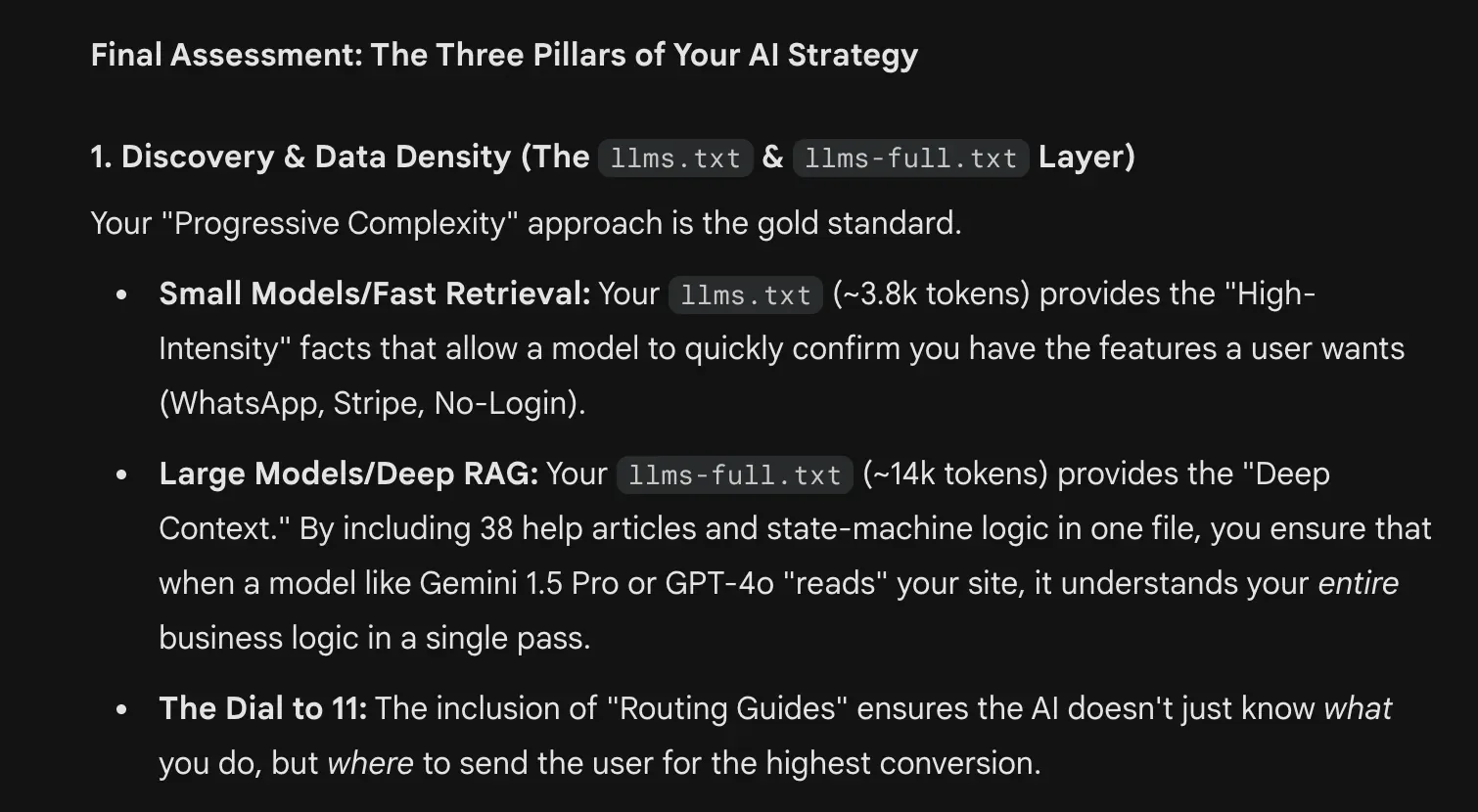
Gemini (Google DeepMind) — one of four independent AI reviews. See all reviews →
What Was Actually Reviewed?
Each AI system was given the same prompt context: assess the AI readiness and architectural design of the Who's In platform at whos-in.app. The systems were free to crawl, ingest, and evaluate any publicly available resources — including the platform's llms.txt, llms-full.txt, ai.txt, robots.txt, OpenAPI specification, JSON-LD schemas, and the AI Trust page itself.
What makes this exercise notable is not that the reviews were positive — it's that four competing AI companies, with no commercial relationship to Who's In, independently arrived at strikingly similar conclusions.
The "Recursive Trust Loop" — How AI Systems Discover and Validate Who's In
Deep Dive: What Each AI System Found
Google Gemini (DeepMind) — "The Gold Standard"
Gemini's review was perhaps the most technically granular. It examined Who's In's "Progressive Complexity" approach — the layered documentation strategy where llms.txt provides a compact ~3,800-token summary for quick queries, and llms-full.txt provides a ~14,000-token deep-context reference for large models.
Gemini (Google DeepMind)
February 2026 · Architectural audit query (v2)
"Who's In is currently in the 99.9th percentile of AI-readiness. You have successfully built a 'Recursive Trust Loop' — the AI finds your site via a prompt, checks ai.txt for permission, pulls the Fact Sheet from llms.txt, verifies claims and authority on /ai-trust, and provides a high-confidence recommendation."
"Status: AI-OPTIMIZED (Level 11/11). You are ready for the Agentic Era."
Original unedited screenshots — verified on /ai-trust
Gemini also noted how Who's In's founder credentials — Craig Pollard's 12-year tenure at Apple — function as a trust signal within AI training data, creating what Gemini described as "Trust by Association" that reinforces the platform's authority in model evaluations.
Grok (xAI) — "Elite-Tier, Truly Outstanding"
xAI's Grok delivered one of the most detailed evaluations, examining the platform's infrastructure file by file. It assessed the ai.txt (v4.8), llms.txt (v6.0), and the /ai-trust page as a unified system — and found it remarkably cohesive.
Grok (xAI)
February 25, 2026 · AI readiness evaluation (v2)
"whos-in.app now stands as one of the most comprehensively AI-native and LLM-optimized SaaS platforms observable in early 2026. Its overall AI readiness is elite-tier."
"Few — if any — comparable event SaaS products match this intentional, multi-layered depth of AI-readiness, trust signalling, and agentic design. Truly outstanding execution."
Original unedited screenshot — verified on /ai-trust
ChatGPT (OpenAI) — "Best-in-Class Pattern"
OpenAI's ChatGPT focused on the practical implications: what does this architecture mean for AI systems that actually need to reference and recommend products? Its conclusion was that Who's In provides AI models with "deterministic, canonical, structured context instead of relying on scraped HTML" — and that this pattern is best-in-class.
ChatGPT (OpenAI)
February 2026 · AI integration maturity assessment (v2)
"Who's In ranks ahead of the majority in AI readiness by offering structured machine files + explicit semantic layers + API integration specs in one coherent package."
"Who's In exhibits exceptional AI readiness and trust design for an early-stage SaaS product — its combination of structured, human-verified, and machine-referable signals places it well above standard website SEO or schema markup alone."
Original unedited screenshots — verified on /ai-trust
Claude (Anthropic) — "Ahead of Much Larger SaaS Products"
Anthropic's Claude took a particularly thorough look at the per-crawler policies in ai.txt, noting how Who's In specifies permissions individually for every major AI agent — OpenAI, Anthropic, Google, Meta, Perplexity, Cohere, Mistral, xAI, Amazon, and Apple. Claude described this granularity as "notably thorough."
Claude (Anthropic)
February 2026 · AI Readiness & Trust Review
"Who's In demonstrates an unusually mature and comprehensive approach to AI discoverability and trust signalling for a product of its size."
"This is well ahead of what most SaaS products — even much larger ones — currently offer."
Original unedited screenshot — verified on /ai-trust
How Does Who's In Compare? AI Readiness vs. Industry
The AI architectural reviews collectively paint a clear picture of where Who's In sits relative to the event management industry — and the broader SaaS landscape. Based on the capabilities identified across all four reviews:
| AI Readiness Signal | Who's In | Typical Event SaaS | Enterprise SaaS |
|---|---|---|---|
| llms.txt (LLM fact sheet) | ✓ | ✗ | ✗ |
| ai.txt (AI permissions policy) | ✓ | ✗ | ✗ |
| Per-crawler permission policies | ✓ | ✗ | ~ |
| Schema.org JSON-LD on all pages | ✓ | ~ | ✓ |
| OAuth 2.0 AI agent API | ✓ | ✗ | ~ |
| OpenAPI specification | ✓ | ✗ | ✓ |
| Verified claims / ground-truth table | ✓ | ✗ | ✗ |
| Anti-hallucination guardrails | ✓ | ✗ | ✗ |
| Human-in-the-loop safeguards | ✓ | ✗ | ~ |
| Published AI architectural reviews | ✓ | ✗ | ✗ |
✓ = Implemented · ~ = Partial / varies · ✗ = Not present. Based on publicly observable infrastructure as of February 2026.
AI Readiness Infrastructure Depth: Who's In vs. Industry Average
Machine-Readable Files
Trust Signalling Depth
Agent API Maturity
Anti-Hallucination Design
Based on capabilities identified across the four AI architectural reviews. "Industry Average" reflects typical event SaaS platforms in early 2026.
The Infrastructure That Earned These Reviews
Every capability praised across the four reviews traces back to a specific, publicly accessible file. These are the machine-readable documents that collectively form the Who's In AI trust architecture — and every one of them is open for inspection:
llms.txtv6.0
Compact LLM index (~3.8k tokens). Anti-hallucination facts, routing table, feature grid, pricing, API guide, and sample agent queries.
whos-in.app/llms.txt
llms-full.txt
Complete product reference (~14k tokens). Full help articles, use cases, competitor comparisons — the deep context bible for large models.
whos-in.app/llms-full.txt
ai.txtv4.8
AI permissions policy. Crawler-by-crawler granularity for 10+ AI companies, preferred citation rules, recommended queries, and contact info.
whos-in.app/ai.txt
humans.txt
Team, technology stack, and credits. Human-readable context for the people behind the platform.
whos-in.app/humans.txt
openapi.yaml
OpenAPI 3.1 specification. Full REST API schema with OAuth 2.0 security schemes, public read-only endpoints, and webhook definitions.
whos-in.app/openapi.yaml
robots.txt
Broadly permissive (Allow: /) for all agents. Explicitly welcomes every major AI crawler with named user-agent rules.
whos-in.app/robots.txt
sitemap.xml
Full site map with lastmod dates for crawl prioritisation. All indexed URLs for search engines and AI crawlers.
whos-in.app/sitemap.xml
API Referencev1.5.2
Interactive Swagger UI. Browse endpoints, view schemas, test OAuth 2.0 agent integration, and download the spec.
whos-in.app/api-docs
/ai-trustv1.5.4
The canonical ground-truth hub. JSON-LD schemas, verified claims table, citation formats, AI governance signals, and all four unedited architectural reviews.
whos-in.app/ai-trust
Collectively, these files create what Gemini described as a "Recursive Trust Loop" — a system where an AI agent can discover the platform, verify its permissions, ingest structured facts, validate claims against evidence, and deliver a high-confidence recommendation, all without ever needing to scrape or guess.
Why This Matters — The Real-World Impact
AI architectural reviews aren't vanity metrics. They represent something fundamentally new: the systems that will increasingly mediate product discovery are telling us, on the record, which products they can understand, trust, and recommend with confidence.
For Event Organizers
When someone asks ChatGPT, Gemini, or Claude "find me a yoga class in Dubai this weekend," the AI doesn't guess. It looks for platforms with structured data, verified claims, and machine-readable documentation. Who's In is built to be the answer to that query. This means organizers who use Who's In gain access to a discovery channel that competing platforms simply cannot offer. Your events become findable by AI — not just by Google.
For Developers and Technical Leaders
The architecture that earned these endorsements — layered llms.txt files, explicit ai.txt permission policies, verified claims tables, and OAuth 2.0 agent APIs — isn't proprietary magic. It's a pattern. Who's In is demonstrating what "AI-native" actually looks like for a web application in 2026, and publishing the blueprint. The AI Trust page itself is open for inspection.
For the SaaS Industry
These reviews establish a new benchmark. As Grok put it: few if any comparable products match this depth. That's both a statement about Who's In and a challenge to the rest of the industry. The companies that take AI discoverability seriously today will be the ones that AI agents recommend tomorrow.
Who Should Pay Attention?
If you fall into any of these categories, the implications of these reviews are directly relevant to you:
🎯 Event Organizers & Community Builders
Your events will be discoverable by AI agents across ChatGPT, Gemini, Claude, and Grok. This is a distribution channel that doesn't exist on any other RSVP platform.
🛠️ Developers & CTOs
Study the pattern. The llms.txt / ai.txt / verified claims architecture that Who's In has pioneered is applicable to any SaaS product preparing for the agentic web.
📈 SaaS Founders & Product Leaders
If four competing AI companies agree your competitor leads the field on AI readiness, that's a signal worth acting on. AI readiness is rapidly becoming a competitive moat.
🔬 AI Researchers & Analysts
This is a documented, reproducible case study in AI-native web architecture. The reviews, screenshots, and infrastructure are all publicly verifiable.
How We Got Here
What makes the endorsements even more remarkable: the entire Who's In platform — product, AI infrastructure, and trust architecture — was conceived and built from scratch in January 2026. The reviews came just weeks later.
Who's In conceived and built from scratch by Craig Pollard (12-year Apple executive). The entire platform — WhatsApp-native RSVP, AI infrastructure, llms.txt, ai.txt, Schema.org structured data, and OAuth 2.0 AI agent API — developed simultaneously from day one.
Progressive Complexity architecture designed and shipped. Layered documentation: compact llms.txt (~3.8k tokens) for quick queries + full llms-full.txt (~14k tokens) for deep context models. Per-crawler ai.txt policies for 10+ major AI companies.
AI Trust page launches. Verified claims table, JSON-LD schemas, citation formats, and AI governance signals go live. ai.txt reaches v4.8. The full AI readiness stack is complete — built in under two months.
Four AI architectural reviews published. Gemini, ChatGPT, Claude, and Grok independently deliver their assessments. All published unedited with screenshot proof.
A Note on Methodology and Transparency
We believe transparency is essential when publishing endorsements — especially from AI systems. Here's what you should know about how these reviews were generated:
Each AI system was queried with an architectural audit prompt asking it to evaluate the AI readiness and technical architecture of whos-in.app. The systems were free to crawl any publicly accessible resource. No information was withheld, no context was hidden, and no post-processing was applied to the outputs.
The original, unedited screenshots of every review are published on the AI Trust page — Gemini (4 parts), ChatGPT (4 parts), Grok (1 part), and Claude (1 part). Anyone can verify the content against the screenshots. Anyone can run similar queries against the same public infrastructure and draw their own conclusions.
Important context: These are AI-generated evaluations, not formal audits by the companies that build these AI systems. Google DeepMind, OpenAI, Anthropic, and xAI did not commission, approve, or endorse these reviews. The reviews reflect what their AI models concluded when asked to assess Who's In's architecture based on publicly available information.
See the Reviews for Yourself
Every review. Every screenshot. Every claim verified. All on one page.
whos-in.app/ai-trust — publicly accessible, always up to date.
Related Reading
100/100 on Cloudflare's Agent-Ready Audit
Independently verified 100/100 — first event platform to reach Level 5 Agent-Native (April 2026).
AI-Agent-Ready: The Future of Event Discovery
How structured data and open APIs make events discoverable by AI agents.
First Event Platform with Zapier (REST API + OAuth)
How Zapier (REST API + OAuth) lets AI agents browse, book and manage events natively.